Why Odds Format Conversions Cause Headaches for International Arbitrage Detection Platforms
Written by Ines Jung · Jun 18, 2026
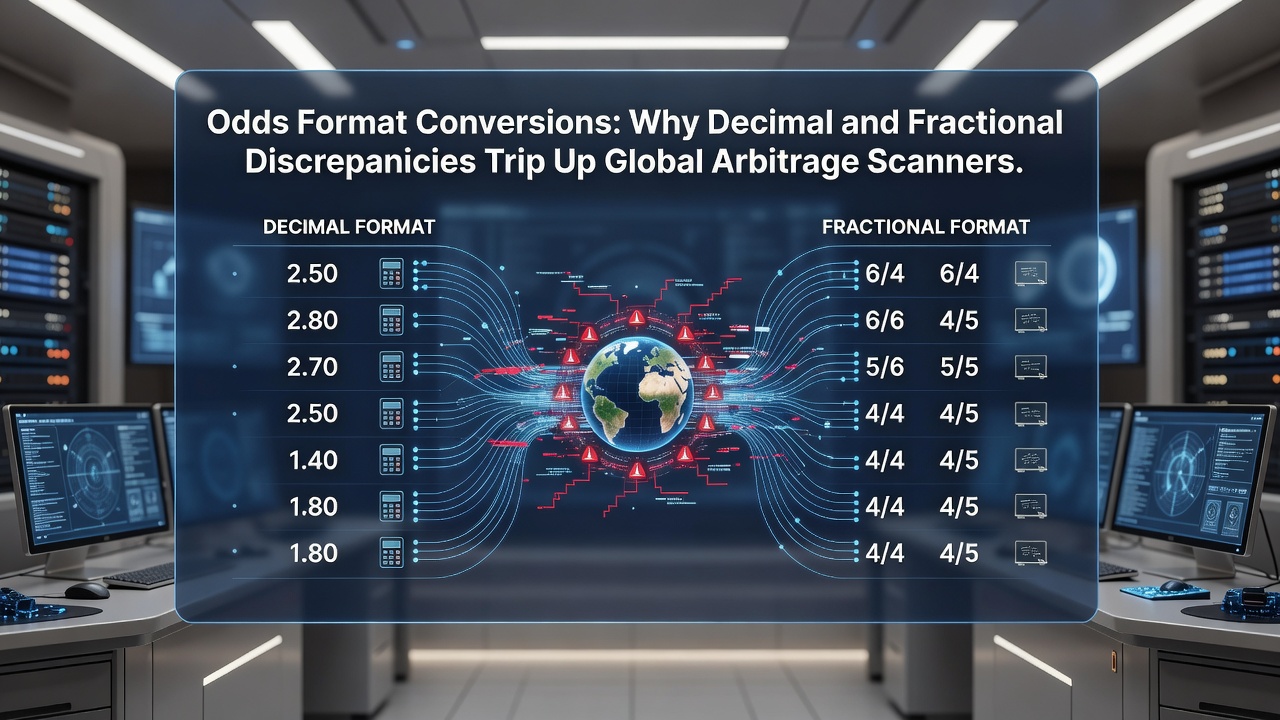
Why Odds Format Conversions Cause Headaches for International Arbitrage Detection Platforms
Arbitrage scanners operate across dozens of international betting platforms where decimal odds dominate European and Australian markets while fractional formats remain standard in the UK and parts of Asia. These scanners pull live data feeds then convert values in real time to identify situations where combined implied probabilities fall below 100 percent. Conversion steps introduce small rounding differences that accumulate when platforms display odds to two decimal places or when fractional representations use simplified denominators.
Core Differences Between Decimal and Fractional Systems
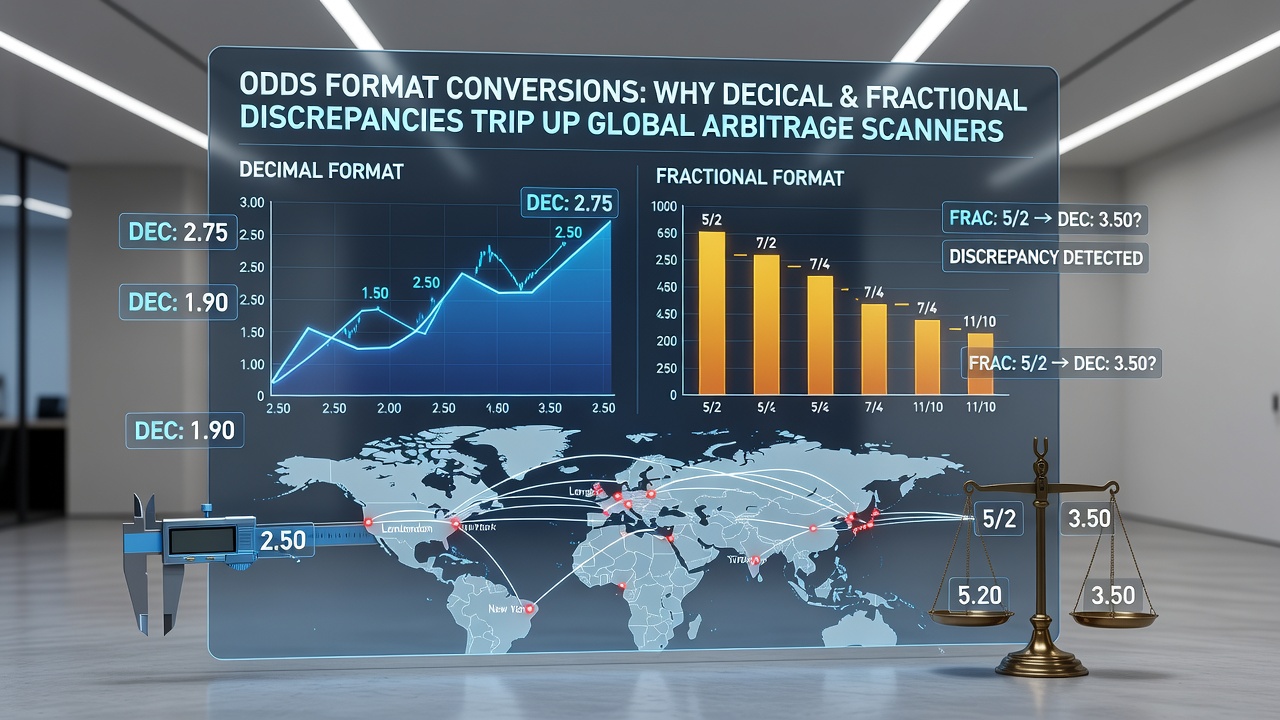
Decimal odds express total return including stake as a single number such as 3.50 which means a one-unit stake returns 3.50 units overall. Fractional odds instead show profit relative to stake using ratios like 5/2 which converts to 3.50 decimal when calculated as (5 divided by 2) plus 1. Global bookmakers apply these formats according to regional conventions and software defaults so scanners must translate every incoming value before comparing implied probabilities across events.
Researchers at several European universities have documented how minor display choices create measurable gaps. One analysis of 2025 match data found that 4.2 percent of apparent arbitrage signals disappeared after precise reconversion because one platform rounded 9/4 (3.25 decimal) while another listed 3.20. Those small variances matter when scanners aggregate hundreds of lines per second across continents.
Mechanics of Conversion and Where Errors Occur
Standard conversion formulas are straightforward yet implementation details vary. To move from fractional to decimal operators add 1 to the numerator divided by denominator while reversing the process requires subtracting 1 then expressing the remainder as a reduced fraction. Automated systems sometimes retain extra decimal places during intermediate steps or apply banker's rounding which shifts results by 0.01 in borderline cases. When multiple bookmakers feed data simultaneously these 0.01 shifts alter whether an opportunity registers as valid or gets discarded.
Regional Display Practices Add Layers
Bookmakers in Australia often list decimal odds to two places while certain Asian exchanges show three places for high-liquidity markets. Fractional boards in the UK frequently reduce fractions to lowest terms so 10/3 appears instead of 20/6. Scanners attempting bulk comparisons must normalize every figure before probability calculations begin or risk generating false positives that vanish upon manual verification.
Data from Canadian regulatory filings released in early 2026 indicate that cross-border betting volumes rose 18 percent year over year partly because scanners now monitor more offshore platforms. That growth increases exposure to format mismatches since operators based in different jurisdictions retain independent rounding rules.
Impact on Real-Time Arbitrage Detection
Scanners rely on millisecond-level consistency when calculating whether three-way or two-way outcomes allow risk-free profit. A single mismatched conversion can flip a marginal 99.7 percent implied probability sum into 100.1 percent and thereby exclude the line from alerts. Operators who update feeds every few seconds compound the issue because each refresh cycle repeats the conversion process across thousands of events.
One documented case from June 2026 involved a tennis match where three European bookmakers listed decimal equivalents of 1.85 2.05 and 4.10 while a UK platform displayed fractional odds of 4/5 21/20 and 3/1. After standardized conversion the combined probability reached 100.8 percent on one scanner but 99.6 percent on another that used different rounding logic. Bettors monitoring both feeds received conflicting signals until they manually reconciled the values.
Technical Adjustments That Reduce Discrepancies
Developers have introduced several mitigation techniques. Some scanners now store raw fractional strings alongside decimal values and perform probability math on the unrounded forms before display formatting occurs. Others apply a tolerance band of 0.02 around each converted figure to account for rounding noise. These adjustments cut false signals but require additional processing power and careful calibration against historical datasets.
Industry reports compiled by the European Gaming and Betting Association note that platforms adopting unified internal decimal standards before external publication reduced downstream scanner errors by roughly 30 percent in controlled tests conducted through 2025. The same reports highlight that legacy systems still using fractional displays for compliance reasons continue to create friction for global monitoring tools.
Broader Implications for Cross-Border Operations
Arbitrage activity spans multiple regulatory environments where odds presentation rules differ. Scanners must therefore handle not only format conversion but also time-zone synchronization and currency translation before final probability checks. When a single event appears on exchanges using decimal odds and others using fractional odds the cumulative effect of small conversion variances can mask genuine opportunities or generate alerts that require immediate human review.
Academic papers published in the Journal of Gambling Studies have examined these dynamics and found that conversion-related noise accounts for a measurable share of rejected signals in high-volume sports such as football and basketball. The studies recommend that scanner algorithms log both pre-conversion and post-conversion figures for audit purposes so operators can trace whether a missed opportunity stemmed from market movement or from rounding artifacts.
Conclusion
Odds format conversions remain a persistent technical challenge for global arbitrage scanners because decimal and fractional systems encode identical probabilities through different numeric representations. Small rounding decisions at the bookmaker level propagate through automated pipelines and alter which opportunities surface as valid. Platforms that standardize internal calculations before publishing data and scanners that preserve raw values during processing both reduce error rates yet the underlying diversity of regional display conventions ensures that discrepancies will continue to appear. Observers tracking June 2026 market activity note that continued growth in cross-border betting volumes will keep pressure on developers to refine conversion logic and tolerance settings in order to maintain reliable detection across all supported formats.